Quetzalcoatl of Mexico - CRUCIFIED

Quetzalcoatl of Mexico - CRUCIFIED
The claims that Quetzalcoatl (often spelled Quexalcote in 19th-century sources) was crucified on a cross between two thieves, died as an atoning sacrifice, and resurrected after three days come directly from Godfrey Higgins’ Anacalypsis (1836), Kersey Graves’ The World’s Sixteen Crucified Saviors (1875), and early colonial Spanish interpretations of indigenous Mesoamerican codices (such as Lord Kingsborough's Antiquities of Mexico).
In authentic Mesoamerican archaeology, epigraphy, and native Nahuatl traditions (the Florentine Codex, Leyenda de los Soles, Codex Borgia), Quetzalcoatl is a primordial creator deity, the Feathered Serpent of wind, rain, and civilization, and a legendary priest-king (Ce Ácatl Topiltzin Quetzalcoatl).
Profile & Biographical Details
- Timeline & Dates:
- Mythicist Claim: Active ~587 BCE.
- Archaeological Reality: Iconography of the Feathered Serpent dates back to the Olmec civilization (~1200–400 BCE), flourished at Teotihuacan (~100–600 CE), and reached its zenith during the Toltec and Aztec periods (900–1521 CE). The historical Toltec ruler Ce Ácatl Topiltzin Quetzalcoatl lived around the 10th century CE.
- Calendar Date of Birth:
- In the Mesoamerican 260-day calendar (Tonalpohualli), his mythical/historical birth is celebrated on the calendar day Ce Ácatl ("1 Reed").
- Manner of Death, Cause & Perpetrator:
- Claim: Crucified on a mountain or in heaven on a cross as a sin offering; nailed to a cross between two thieves.
- Native Mesoamerican Myth: In the Anales de Cuauhtitlan, Quetzalcoatl was tricked into intoxication and dishonor by his rival deity Tezcatlipoca. Overcome with remorse, he left Tula, traveled east to the Gulf Coast (Tlillan-Tlapallan), dressed in his divine feathered regalia, and cremated himself on a funeral pyre. His heart and ashes rose into the heavens to become the Morning Star (Venus / Tlahuizcalpantecuhtli). Alternatively, he sailed east on a raft of serpents.
- Geographical Locations:
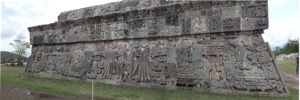
- Active across Central and Southern Mexico: Teotihuacan, Tula (Hidalgo), Cholula (Puebla, home to his largest temple), Tenochtitlan, and the Maya lowlands (where he was venerated as Kukulkan in Chichen Itza and Q'uq'umatz in highland Guatemala).
Theological Details: Mythicist Claims vs. Mesoamerican Records
| Category | 19th-Century Mythicist Claim (Graves/Higgins/Kingsborough) | Authentic Mesoamerican Archaeology & Codices |
|---|---|---|
| Virgin Birth | Born of the virgin Chimalman by immaculate conception. | In the Leyenda de los Soles, his mother Chimalman conceived him after swallowing an emerald/jade stone (chalchihuitl), or through the celestial hunter-god Mixcoatl. |
| Crucifixion | Nailed to a cross as a sin offering to save mankind. | Mesoamericans did not practice crucifixion. The four-armed "cross" in codices like Codex Borgia is the Mesoamerican World Tree (Axis Mundi), symbolizing the four cardinal directions and the cosmic center. |
| Salvation / Atonement | Died for the remission of human sins. | Descended to the underworld (Mictlan) to retrieve ancestral bones from the death-god Mictlantecuhtli. He bled his own organ over the bones to create the fifth sun's human race—a myth of creation, not moral sin atonement. |
| Resurrection & Descent | Descended to hell, lay in a tomb 3 days, and resurrected. | Transformed celestial forms: his self-immolation caused his soul to vanish for four days, spend four days in the underworld, and on the eighth day appear as the Morning Star (Venus). |
| Title: "Son of God" | Deemed "Lord and Savior," "Redeemer," and "Only Begotten." | Titled Ehecatl (Wind God), Tlahuizcalpantecuhtli (Lord of the Dawn), Ce Ácatl (1 Reed), and Topiltzin (Our Prince). |
| Part of a Trinity | Second person of a Mexican Trinity. | One of four creator sons born to the primordial dual deity Ometeotl (the four Tezcatlipocas: Red/Xipe Totec, Blue/Huitzilopochtli, Black/Tezcatlipoca, and White/Quetzalcoatl). |
| Judgment in Heaven | Returns at the end of time to judge mankind in heaven. | Mesoamerican afterlife was determined not by moral judgment in a heavenly court, but by how one died (e.g., drowning led to Tlalocan; battle or childbirth led to the Sun realm; natural causes to Mictlan). |
Appearance, Worship, and Source of Confusion
- Visual Representation:
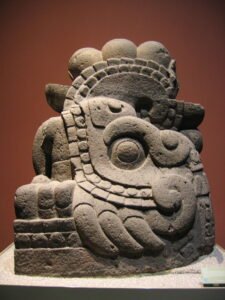
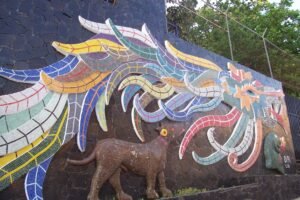
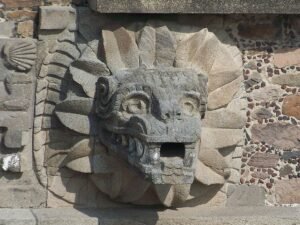
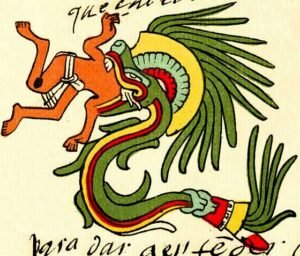
- As a serpent: A giant rattlesnake body covered in iridescent green quetzal feathers.
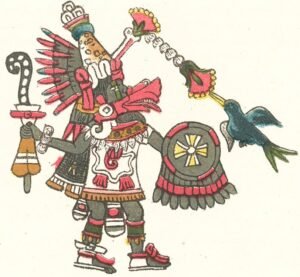
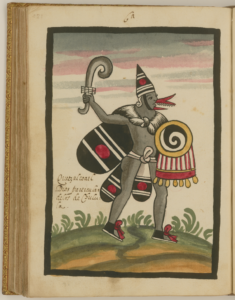
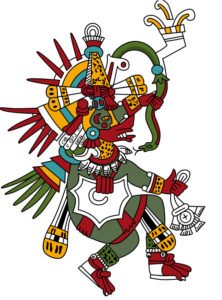
- In anthropomorphic form (Ehecatl): A deity wearing a duck-bill wind mask, a conical hat (copilli), a cut conch-shell breastplate (ehecacouzcatl), and holding a curved wind staff.
- Worship & Rites:
- Revered especially at Cholula, where priests performed ritual fasting, bloodletting (autosacrifice using maguey thorns), incense burning, and offerings of birds, butterflies, and jade. Unlike many other Aztec cults, historical Toltec traditions associated with Quetzalcoatl favored animal and symbolic offerings over human sacrifice.
- Why the Mythicist Parallels Arose:
- Colonial Syncretism: Following the 16th-century Spanish conquest, Dominican and Franciscan friars (such as Diego Durán and Bernardino de Sahagún) tried to explain native symbols (such as the four-directional world tree and ritual water baths) by claiming that the Apostle Saint Thomas had visited the Americas.
- Lord Kingsborough's Antiquities of Mexico (1830s): Kingsborough spent a fortune publishing native codices, attempting to prove the indigenous peoples were the Lost Tribes of Israel, interpreting world trees in Codex Borgia and Codex Vaticanus B as "crucifixions," which Kersey Graves later copied uncritically.
The cruciform motif found across pre-Columbian Mesoamerican codices, stone monuments, and temple walls is the Mesoamerican World Tree (Axis Mundi).
Cosmological Structure: The Quincunx & Three Realms
Mesoamerican cosmology conceived the universe in two interlocking dimensions:
- Horizontal Plane (The 4 Directions & The Center):
- Known as the quincunx (a 4-petaled / 5-point layout).
- The universe was divided into four cardinal directions, each demarcated by a directional tree, associated with specific colors, birds, patron deities, and day-signs.
- At the precise center stood the Fifth Direction—the green or central Axis Mundi—which unified all directions.
- Vertical Plane (The Layered Universe):
- Overworld (Celestial Heavens): Typically 13 layers populated by solar and starry deities.
- Middle World (Earth): The terrestrial realm of human existence and agriculture.
- Underworld (Mictlan / Xibalba): The 9 watery, subterranean layers of death and ancestral regeneration.
- The roots of the World Tree anchored in the underworld, its trunk traversed the earth, and its canopy supported the sky.
Key Visual Components in Codices & Bas-Reliefs
| Element | Visual Iconography in Art/Codices | Cosmological Meaning |
|---|---|---|
| Trunk & Branches | Depicted as a Ceiba tree (Yaxche), maize plant, or T-shaped bar with spiked bark. | The cosmic conduit through which life-energy, deities, and ancestral spirits travel between realms. |
| The Base / Roots | A crocodilian earth-monster (Cipactli), skull, or water-lily monster. | The underworld entrance and the primordial watery surface upon which the earth floats. |
| The Canopy Summit | A celestial bird (e.g., the Harpy Eagle, Quetzal, or Itzamnaaj). | Represents solar fire, the upper heavens, and celestial governance. |
| Bicephalic Serpents | Crossbars ending in open serpent jaws or jade ornaments. | The ecliptic path of the sun, moon, and planetary deities across the sky. |
Primary Codex & Archaeological Examples
- Codex Fejérváry-Mayer (Page 1):
- One of the most complete depictions of Mesoamerican space-time.
- Features the fire god Xiuhtecuhtli in the center, flanked by four T-shaped directional trees pointing East (top), North (left), West (bottom), and South (right), surrounded by the 260-day calendar cycle (Tonalpohualli).
- Codex Borgia (Pages 49–53):
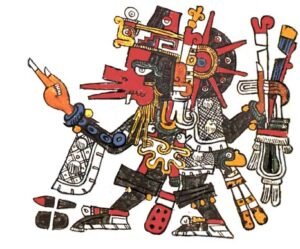
- Illustrates the four directional trees linked with various manifestations of Quetzalcoatl, Tezcatlipoca, and seasonal weather auspices.
- Palenque: Sarcophagus of K'inich Janaab' Pakal & Temple of the Cross:
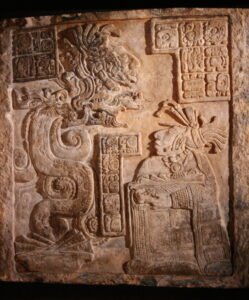
- In classic Maya art, the deceased ruler Pakal is shown reclining at the base of a cruciform Ceiba/Maize tree as he transitions through the jaws of the underworld toward rebirth as the Maize God.
Why Early Colonizers Misidentified the Tree
When 16th-century Spanish friars and 19th-century antiquarians (such as Lord Kingsborough) encountered native depictions of cruciform trees with roots at the base and birds at the top, they interpreted them as Christian crucifixes.